
This article sort of assumes you're into music production in some form. If you're not, it's probably going to put a big ol' yawn on your face. For that I apologize.
This is written in JUCE, which is a framework for making audio plugin. The source code assumes you have the Projucer installed, which is pretty nice tool for setting up all the build information and libraries associated with JUCE. It's designed to be cross-platform and does a nice job of it.
But if you don't want to go through the trouble of building it you can also just get the VST directly and copy it into your own VST folder (C:\Program Files\Steinberg\VSTPlugins is a popular location). Currently there is no fancier way of installing this.
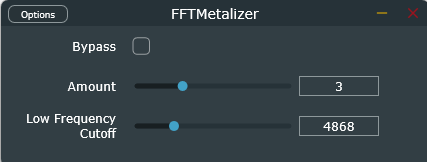
But what is it? It's an audio plugin that performs a fast fourier transform of an incoming audio signal, then proceeds to jiggle all the frequencies around a little bit, producing a slightly inharmonic character to the sound. It has a low-cut filter to stop it from messing with low frequencies which tend to sound messier than the higher ones, and it has an "amount" parameter which tells it how much to mess up the sound.
Currently it processes the left and right stereo channels seperately which does strange things to the stereo image. Could be useful, but probably not what you want. Future version will have this configurable.
How it does this is by swapping the contents of the "frequency bins" associated with the FFT (Fast Fourier Transform). The larger the amount parameter, the farther away the bins can be from each other. The "amount" parameter is the maximum distance, and all the distances are otherwise randomized.
This is pretty crude overall. I know there is a way to use phase information to get more accurate frequencies and to get more fine-grained control over the actual amount of frequency scrambling desired. We'll get to this later. I wrote all this shit today and I'm tired.
Mostly is was a way for me to try to do a little work with the Fast Fourier Transform, and to try to actually make an audio plugin, which I've being dreaming of doing for a while. I am hugely indebted to Matthijs Hollemans at https://audiodev.blog for leading me through it, and in fact I'm using some of his code. The whole article about the FFT and how to perform it is here: https://audiodev.blog/fft-processing/.
And here is a little video of the thing in action: